

The disruption due to Covid 19 had us rethinking our approach to all aspects of the graduate recruitment lifecycle and we have learned the value of utilising digital platforms that enable us to scale processes whilst saving both time and costs. As we continue to navigate the changes we must, however, question whether cost cutting measures are sustainable in the long term and what graduate attraction is going to look like in the future.
Our most recent Employer Benchmarking Insights, 20231, tells us that 61% of graduate recruiters are challenged by high levels of competition for [good] graduates. At the same time, just over a third are concerned about budget constraints.
We analysed pre- and post-covid spend on graduate recruitment marketing and attraction, plotted against the median number of graduates being targeted.

As is evidenced in the table above, we are seeing steady growth in the median number of graduate vacancies – despite the pandemic and increasingly tough economic circumstances. However, the median spend on marketing and attraction activities has been going in the opposite direction with overall spend almost halving from R262 500 in 2020 to R150 000 in 2023!
Whilst there were some career fairs hosted in 2022, 2023 was the first year in which recruiters could contemplate a proper return to in-person events at many of our universities. In chatting to careers service colleagues from the University of Pretoria (UP), University of Cape Town (UCT), and Nelson Mandela University (NMU) we discovered two different scenarios that played out this year. UP and UCT confirmed that employer attendance of career fairs had been high and, in some cases, over-subscribed. Advertising in handbooks has also remained popular. NMU, on the other hand, has seen fewer organisations returning to in-person events on campus with more of a local presence at their career fairs than used to be the case. In some cases, employers are sharing QR codes, rather than investing in printed material and in others (specific mention was made here of the Auditing and Legal firms) there is less being spent on freebies. All three institutions have observed a shift in the mix of services that employers are utilizing. Use of showcase events, on-campus presentations, case studies and hiring of interview facilities on campus has declined as more employers are opting for virtual presentations and interviews. Other services seeing less traction are SMS and Email blasts to students.
So, then, how are employers getting by with less and what are they doing differently? The table, below, shows how employers are apportioning their spend on different campaign elements and, again, we tracked this pre- and post-covid.
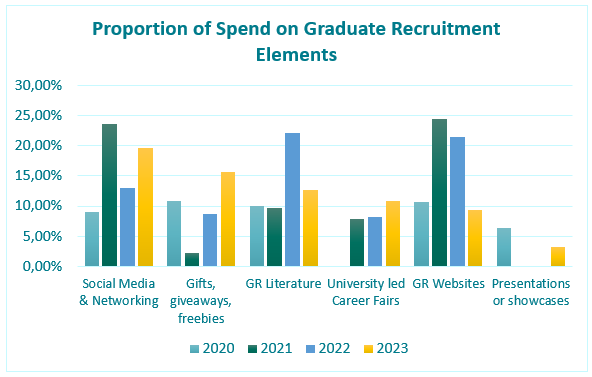
Spend on social media and networking sites as well as websites spiked during Covid, with social media spend remaining at a similar level and website spend generally returning to pre-covid levels in the last year. Some employers are spending more on freebies and giveaways! There is a definite return to career fairs however employers are, perhaps, being more discerning about which fairs they attend and are retaining a mix of in-person events for some campuses whilst attending virtual events for campuses in less accessible locations.
Our colleagues pointed out that most of the students attending events post-Covid have no prior point of reference – in other words, they are not making comparisons to pre-Covid events. This also means that they are unfamiliar with employer brands and offerings. Getting the balance between tech and touch is critical and it seems clear that students want to engage with employers via career fairs, showcases and other in-person options. There is as much work to be done by employers who want to establish themselves as employers of choice. Getting by with less in a highly competitive market may not be sustainable if employers want to retain their hard-earned positions as Employers of Choice.
20231 The SAGEA Candidate Insights Survey 2023 questioned 2,431 new or future employees about their job hunting and opinions about the job market.