

In the landscape of higher education, university rankings have become a focal point for decisions made by students, parents, and employers alike. With as many as forty-seven sources producing these rankings, it’s essential to approach them with discernment. This article delves into three prominent ranking systems that we believe are the most well-established: QS World University Rankings, Times Higher Education (THE) World University Rankings, and the Academic Ranking of World Universities (ARWU), exploring their methodologies and implications.
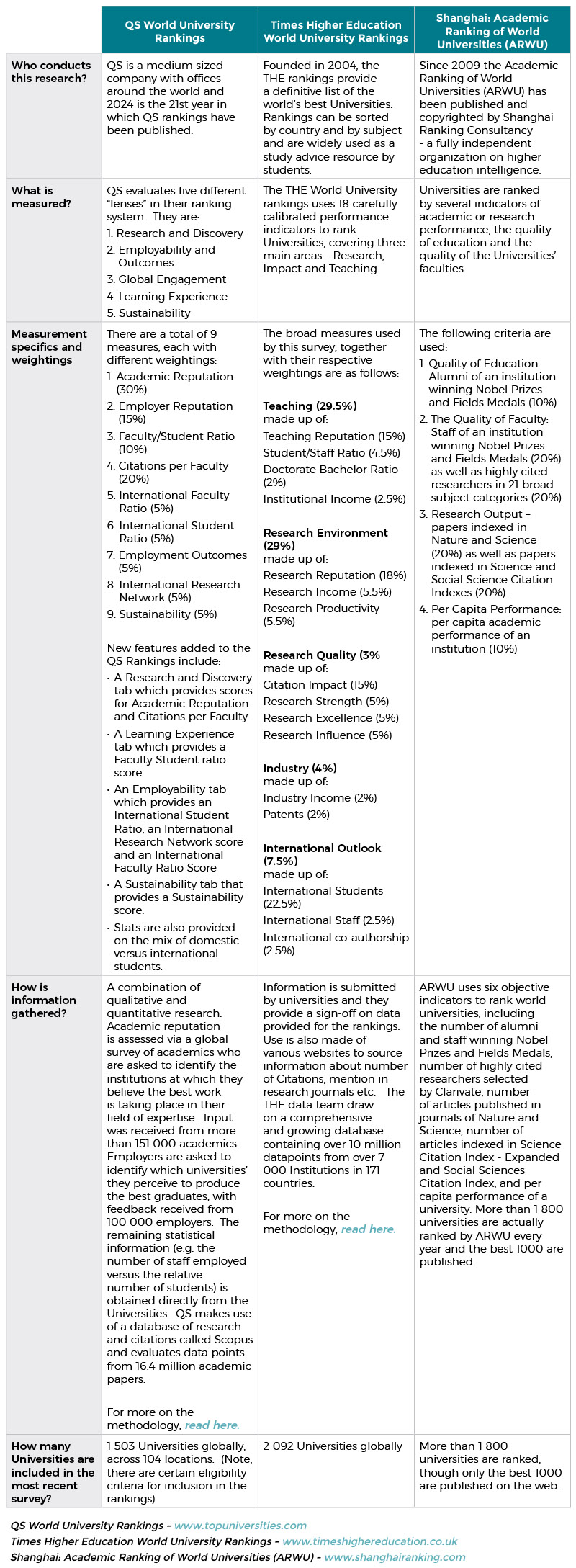
The table, below, provides you with a comprehensive overview of the three surveys, what they measure, how weightings are allocated, and the methodology applied in arriving at a ranking.
An important question is how do our South African Universities fare in each of the above-mentioned studies and is there consistency in their rankings across the different studies? The table below shows a comparison between our rankings in 2015 and the most recent rankings available for each survey.
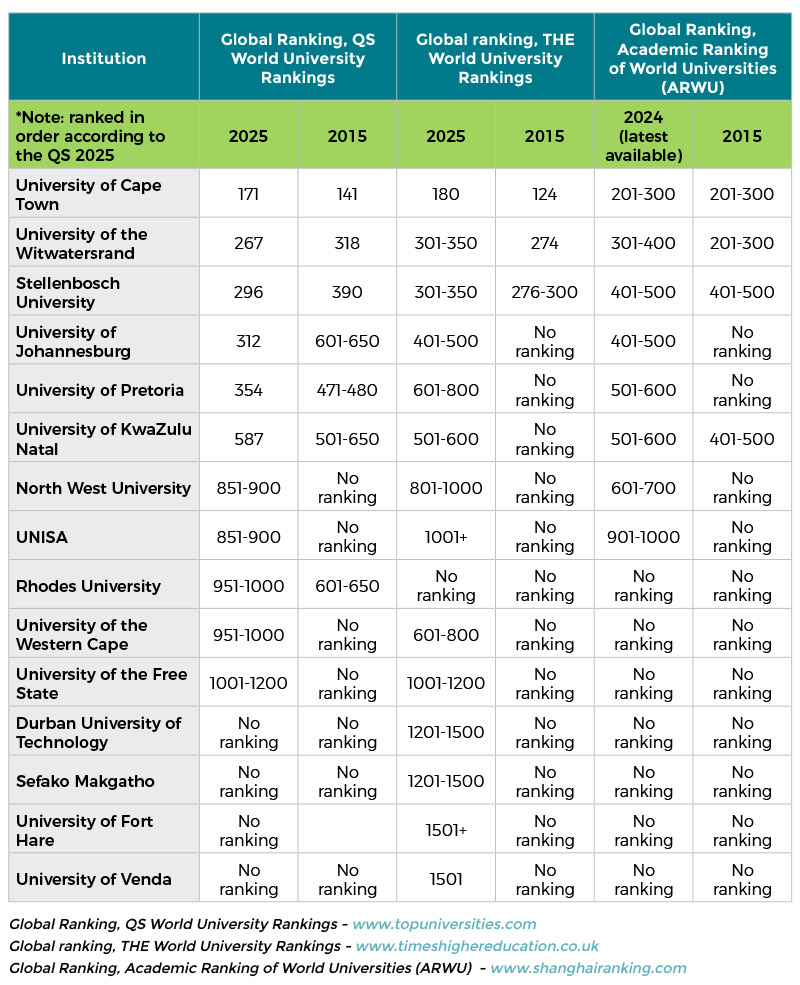
Between 2015 and 2025, almost all our universities have dropped down the list in each of the respective surveys. There are multiple reasons for our declined rankings, including the effects of the pandemic, fees issues at some or our HEI’s and the growth in student numbers. If you are not already familiar with university rankings and are reading about them for the first time, there are some important pointers to consider. These are as follows:
- Always question the source of the rankings and ask yourself, “is this a reliable and reputable ranking source?
- Evaluate what measures the ranking is based on and compare this to your needs.
- Pay attention to the broader trends in rankings rather than fixating on small positional changes. Is a rank of 171 significantly different from 175 in context?
- Understand what is being measured, what the sample size is and whether, when comparing data, you are comparing like with like.
- Our analysis of the three different surveys reveals that different methodologies and weightings are used across the three surveys. If you compare the order in which our HEI’s appear in the different rankings, there is not much difference – and that highlights an element of consistency and validity, despite the use of different measures and methodologies.
- All three rankings can be “sliced and diced” by Faculty as well as by subject (the QS survey tells us more about our Universities by Faculty/Subject than the other). If, for example you look at the QS rankings for Engineering and Technology then the University of Pretoria ranks ahead of Stellenbosch University and the University of Johannesburg. Similarly, the University of KwaZulu Natal’s ranking for Life Sciences and Medicine is 351 – compared to an overall ranking of 501-600. The University of Pretoria ranks ahead of the University of Cape Town for Accounting and Finance and Stellenbosch ranks ahead of the University of Cape Town in Agriculture and Forestry.
- It is therefore important to know how to use this information and comparisons by subject and faculty will be important for employers who are making strategic decisions about which institutions to target for graduate employment.
- Our 2024 SAGEA Employer Benchmarking study revealed that the median number of universities targeted by employers was nine.
- Our research also tells us that seven universities had more than half of employers targeting these institutions: the University of Pretoria; the University of Johannesburg; the University of Cape Town; the University of the Witwatersrand; Stellenbosch University; the University of KwaZulu-Natal; and North-West University.
- Our 2024 SAGEA Candidate Insights research indicates that 59% of students will take a university’s reputation into account when deciding where to study, with 51% evaluating the reputation of the course they are thinking of taking.
In conclusion, the University rankings can be a valuable source of information for both students and employers, remembering that they are just one piece of the puzzle in evaluating the quality and fit of an institution. Ultimately, rankings should complement, not dictate, decision-making in and about higher education. The QS survey seems to be the most widely used and their methodology does include qualitative input from academics and employers.
And finally, the most important thing to take note of is this: There are approximately 20 000 Universities in the world and, according to the QS rankings UCT, Wits, Stellenbosch, UJ and UP rank in the top 500 Universities in the world with a further five Universities (UKZN, Rhodes, UWC, NWU and UNISA) ranking in the top 1000 Universities in the world!
PS – to read more about opinions on the use of rankings please read these two articles:
1. How useful are rankings? Four questions to help you decide