

A degree still offers the best protection against unemployment in South Africa – but that protection is eroding. Here is what the data says, why it is happening, and what our community can do about it.
South Africa’s unemployment crisis is, by any measure, severe. In the first quarter of 2026, the national unemployment rate stood at 32.7% with nearly one in three people in the labour force unable to find work. For decades, the conventional wisdom held that a university education was a reliable escape from those odds. The data still supports that view, but with a sobering caveat: graduate unemployment has been rising steadily for over a decade, and the trend shows no sign of reversing on its own.
For SAGEA members – employers who hire graduates, foundations who fund them, careers services who prepare them, and solution providers who support the ecosystem – understanding the full picture is the first step toward acting on it.
Education still protects – but the gap is narrowing
The education premium in South Africa’s labour market is real and significant. A person who did not complete secondary school faces a 37.6% unemployment rate. Completing matric reduces that to 35.7%, still above the national average. A post-school diploma or certificate brings it down to 22.2%. A bachelor’s degree or higher: 12.2%.
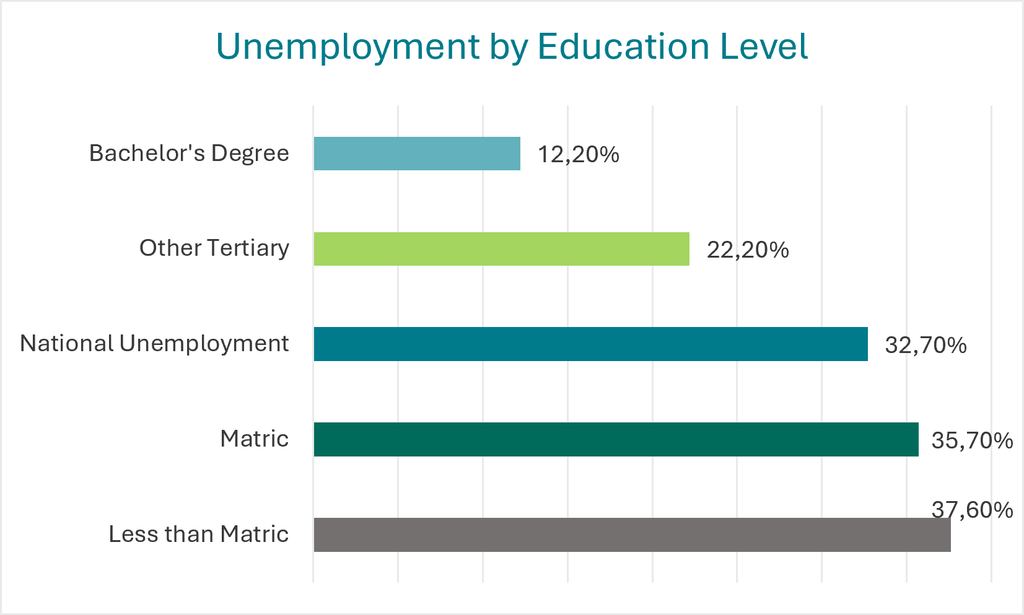
But unemployment rates only count people actively looking for work. A fuller picture emerges from the employment-to-population ratio – the share of all working-age adults who have a job. Here, the education ladder is even more striking.

Every step up the education ladder adds at least 12 percentage points of employment. The single biggest jump – 22 points – is from matric to a diploma. The degree premium over matric is 36 points. In a country where only 14% of the working-age population holds any tertiary qualification, these differences matter enormously.
“Rising education levels have not been enough to move the headline unemployment number downward – because the economy has not been creating jobs fast enough to absorb the growing, better-qualified workforce.” – Stats SA QLFS Q1 2026 analysis
Graduate unemployment has nearly doubled since 2008
In 2008, the higher education unemployment rate stood at around 5.9%. By 2026, it has approached 10% – close to doubling in under two decades. For TVET college graduates, the deterioration has been even sharper: from 13.7% to 21.5%. As Professor Haroon Bhorat, one of South Africa’s leading labour economists, notes, these are “exceptionally high graduate unemployment rates for a developing country.”
The trend is confirmed across qualification levels. Degree holders’ employment-to-population ratio peaked at 84% in 2017 and has declined to 78% by Q1 2026. For diploma and certificate holders, the fall has been steeper still: from 74.7% in 2014 to 64.3% today – a drop of more than 10 percentage points in just twelve years.
The youth dimension
- Young people aged 15–34 make up 49.7% of the working-age population – roughly 21 million individuals.
- The youth unemployment rate stands at 45.6%; for those aged 15–24, it reaches 60.9%.
- Among young adults without matric, only 17% are employed. Completing matric raises that to 29%.
- A diploma lifts youth employment to 52%; a degree to 69% – but even that leaves nearly a third of young graduates without a job.
- Female graduates face a harder path: 11% of all female higher education graduates cannot find work, versus 9% for males – and both rates have increased by at least 4 percentage points over the past decade.
Three forces are driving the crisis
Graduate unemployment is not a single problem with a single solution. The research points to three interlocking causes.
1. An economy that is not growing fast enough
South Africa’s economy has grown by an average of just 1.2% per year over nearly three decades – a “long-run middle-income growth trap.” No amount of education reform can fully compensate for an economy that simply is not generating enough jobs. The national unemployment rate rose from 23.2% in Q1 2008 to 32.7% today, despite a growing share of the population holding tertiary qualifications. Without significantly higher GDP growth, the labour market will continue to be unable to absorb new graduates.
2. A structural mismatch between qualifications and demand
South Africa’s economy has shifted away from low-productivity agriculture toward financial services and the public sector – both of which favour highly skilled workers. There is no evidence of the manufacturing-led structural transformation that, in comparable developing economies, created mass low- and middle-wage employment. The result is a sectoral pattern of growth that systematically reproduces income inequality and leaves semi-skilled workers behind.
3. A mismatch between what graduates study and what employers need
Study choices are not sufficiently aligned with fields where skills are scarce or have high employment prospects. Graduates from humanities and arts faculties consistently face lower employment prospects; those from health, education, and selected applied sciences fare better. This is compounded by variation in institutional quality: university graduates tend to experience better employment probabilities and higher earnings than graduates from other tertiary institutions.
Despite high unemployment rates for entry level positions, the South African Graduate Employers Association (SAGEA), represented by some of the largest and most well-respected organisations that have a programmatic approach to building talent has for more than 20 years tracked unfilled vacancies. The chart below tracks graduate vacancies not filled over the last five years among some of these employers. Whilst some shortages relate directly to supply and demand, there are other nuances that come into play, such as location of roles, students being unaware of what roles they qualify for and what might match their qualification and skills.

Unfilled Graduate Vacancies: 2020-2025; Source: SAGEA Employer Benchmarking Research 2020-2026
What our community can do
Collective action across the ecosystem
No single actor in this ecosystem can solve a problem rooted in macroeconomic structure, institutional quality, and skills mismatch. But each member of our community has a specific and meaningful role to play.
Graduate employers
- Invest in structured learnerships, internships, and graduate programmes that explicitly build work experience – the single most cited missing piece for new graduates.
- Review whether your recruitment criteria unintentionally screen out graduates from historically disadvantaged institutions.
- Consider partnering with universities and TVET colleges to co-design curricula that reflect real employer needs, particularly in fields where the mismatch between training and demand is widest.
Foundations
- Financial support that ends at graduation is not enough. Extend bursary and scholarship programmes to include post-graduation career support, mentorship, and networking.
- Prioritise funding for fields with genuine labour market demand – health, engineering, digital skills – while supporting students from disadvantaged institutions where graduate unemployment is highest.
University careers services
- Career guidance must begin in first year, not final year and proper consideration must be given to compulsory elements of career guidance across curricula.
- The data on field of study and employment outcomes is now robust enough to inform honest, early conversations with students about labour market realities without deterring aspirational choices.
- Build employer relationships that translate into real work experience opportunities.
- Pay particular attention to African, female, and young graduates – the three groups the research identifies as most disadvantaged within the graduate cohort.
Solution providers
- The graduate recruitment ecosystem has a role to play in reducing information asymmetry -connecting students to opportunities, helping employers identify talent beyond the most well-resourced institutions, and building platforms that surface skills rather than credentials alone.
- Digital access remains a barrier; solutions that work on low-bandwidth or mobile-first environments will reach students whom current platforms miss entirely.
“Strategies including the provision of career guidance, promotion of learnerships and internships for skills development, and sustained efforts to improve access to higher education are imperative.” – MacGinty, H. — Graduate Unemployment in South Africa, March 2024
The degree still matters – and so does this community
A degree remains the single most effective labour market advantage available to a young South African. Of every 100 working-age adults with a bachelor’s degree, 78 are employed – compared to 42 among those who completed only matric, and just 30 among those who did not. That advantage is worth fighting to preserve and extend.
But the trend lines are pointing in the wrong direction. Graduate unemployment is rising, the employment premium is eroding, and the groups least able to absorb these shocks – young, female, and African graduates, and those from under-resourced institutions – are bearing the greatest burden. The macroeconomic constraints are real and cannot be wished away. Yet within those constraints, SAGEA members have more collective leverage than any individual actor to shift outcomes: connecting supply to demand, improving the quality and relevance of graduate preparation, and ensuring that the investment in a degree translates, wherever possible, into meaningful employment.
The data is clear: more graduates, but not enough jobs. There is a growing gap between what people study and what employers need. If we don’t act now, we perpetuate a system where education no longer leads to opportunity. This is not just a government issue, it’s a shared responsibility within an ecosystem of students, employers, educators, and funders. There is an imperative to work together and focus our attention on practical pathways into jobs.
We understand the problem. What matters now is action. Let’s move together, fast and at scale.
Sources: Statistics South Africa Quarterly Labour Force Survey Q1 2026; Stats SA QLFS microdata 2014–2026; Bhorat, H. et al. (2017); MacGinty, H. (2024), Graduate Unemployment in South Africa; Pauw et al. (2008); Moleke (2006); Oluwajodu et al. (2015). Graduate Unemployment Amidst a low growth trap, Bhorat, H – SAGEA Conference presentation, November 2025. All unemployment rates use the official (narrow) definition unless otherwise stated.